

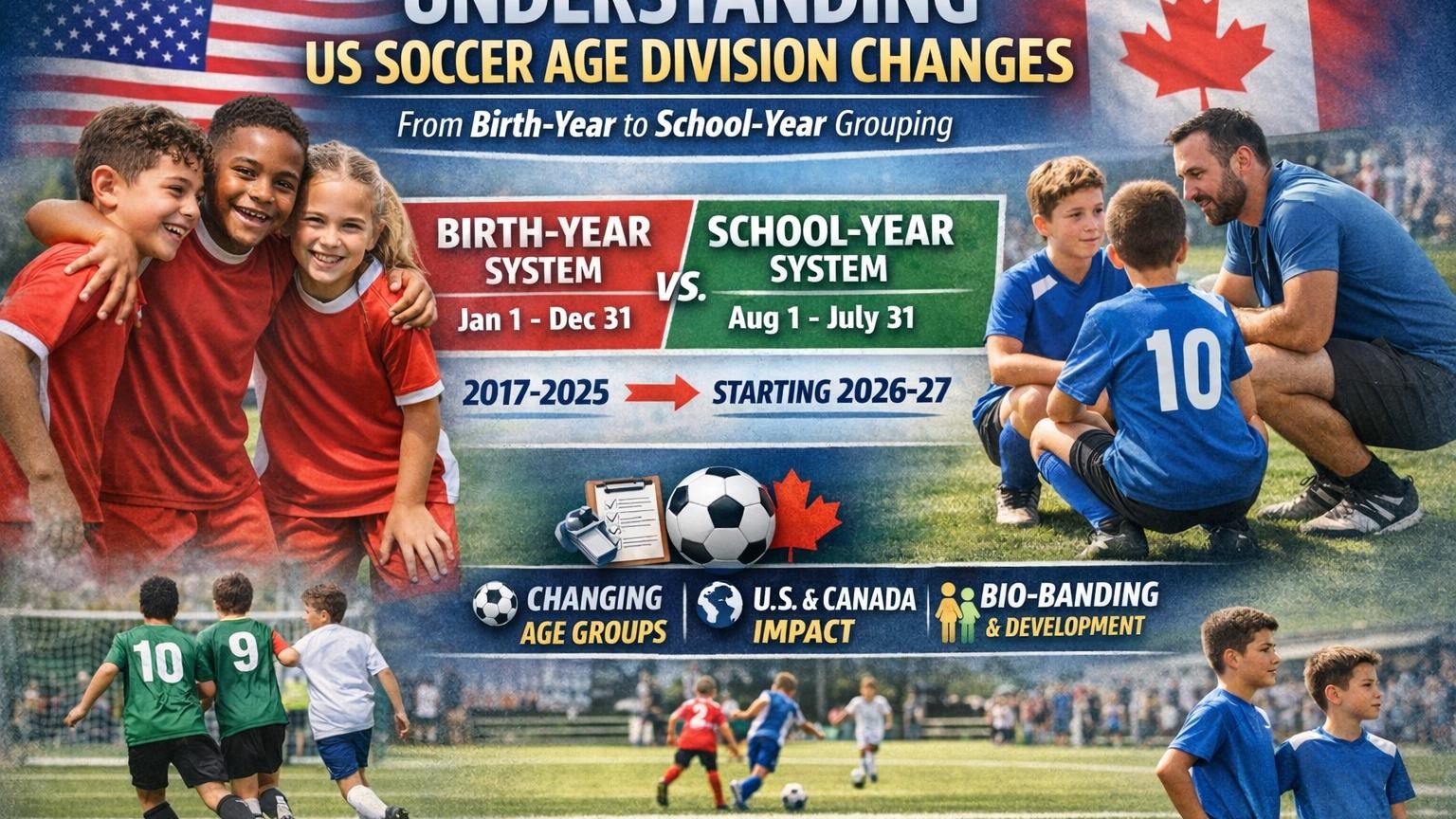
Understanding US Soccer Age Division Changes: A Comprehensive Guide for Parents and Coaches
Are you a parent or coach navigating the evolving landscape of youth soccer in the United States? If so, you’ve likely heard about the recent US Soccer age division changes. These updates aim to enhance player development, align with school calendars, and improve the overall experience for young athletes. In this article, we’ll dive deep into the history, reasons, and implications of these shifts, ensuring you have all the information needed to prepare for the upcoming seasons. Moreover, we’ll explore how these changes could impact your child’s team and provide practical tips for a smooth transition. Additionally, for those in neighboring regions like Canada, we’ll examine the potential ripple effects on youth soccer, particularly in British Columbia. Furthermore, we’ll discuss how these age adjustments align with innovative approaches like bio-banding.
Table of Contents
– The History of Age Division Changes in US Soccer
– Why the Shift Back to School-Year Grouping?
– Key Details of the 2026-27 Changes
– How Will This Affect Players and Teams?
– The Ripple Effect: How US Changes Influence Canadian Youth Soccer in British Columbia
– Alignment with Bio-Banding: Enhancing Youth Development
– Benefits and Potential Challenges
– Preparing for the Transition: Tips for Parents and Coaches
– Frequently Asked Questions
– Conclusion
The History of Age Division Changes in US Soccer
To fully grasp the current US Soccer age division changes, it’s essential to look back at how we got here. Initially, before 2017, most youth soccer programs in the US organized age groups based on a school-year cycle, typically running from August 1 to July 31. This approach allowed children to play with their classmates, fostering stronger social bonds and team chemistry.
However, in 2016, the U.S. Soccer Federation (USSF) mandated a switch to birth-year grouping, effective from the 2017-18 season. Under this system, age divisions were determined by the calendar year, from January 1 to December 31. The primary goal was to align US youth soccer with international standards, such as those used by FIFA, which could potentially benefit national team development and scouting. Additionally, this change was intended to support small-sided games and overall player growth.
Despite these intentions, the birth-year mandate created several issues. For instance, it led to “trapped players”—children born in certain months who were separated from their school peers. Parents and coaches frequently voiced concerns about mismatched emotional and physical development within teams. Furthermore, retention rates suffered as some kids felt disconnected from their friends.
Fast forward to late 2024: US Soccer removed the birth-year mandate, empowering organization members like US Youth Soccer (USYS), American Youth Soccer Organization (AYSO), and US Club Soccer to choose their preferred age formation cycles. This flexibility marked a significant turning point. In March 2025, these major bodies initially announced a return to a September 1-August 31 cycle. But after gathering more feedback, they refined it in June 2025 to an August 1-July 31 alignment, set to begin in the 2026-27 season.
Why the Shift Back to School-Year Grouping?
The decision to revert to school-year age divisions wasn’t made lightly. First and foremost, it addresses longstanding feedback from families, coaches, and players. According to USYS, AYSO, and US Club Soccer, the August 1-July 31 cycle better aligns soccer with academic calendars, allowing more children to play with their classmates.
Moreover, this change aims to minimize the number of trapped players. Under the birth-year system, kids born in August through December often ended up in older groups, while those born in January through July stayed with younger peers—disrupting social dynamics. By contrast, the new model promotes emotional and physical consistency within teams, potentially boosting retention and enjoyment.
Additionally, the shift supports college recruitment. Scouts can now evaluate players from the same high school graduating class together at tournaments, simplifying the process. US Soccer has even introduced an [age group calculator tool](https://www.ussoccer.com/ecosystem-review/player-registration/age-group-calculator) to help parents understand placements. Overall, the emphasis is on growing the game at the grassroots level, where the majority of participation is recreational rather than elite.
Key Details of the 2026-27 Changes
Let’s break down the specifics. Importantly, there are no alterations for the 2025-26 season—everything remains under the birth-year system. The new rules kick in starting with the 2026-27 registration year, which typically begins in the fall of 2026.
– **New Cycle**: Age groups will be formed from August 1 to July 31.
– **Affected Organizations**: This applies to USYS, AYSO, US Club Soccer, and related leagues like ECNL, MLS NEXT (Academy Division), and others.
– **Flexibility**: While these major bodies are adopting the August-July model, US Soccer allows members to choose alternatives like September-August or stick with birth-year if it suits their programs.
– **Age Group Examples** (for 2026-27 season):
| Age Group | Birth Dates |
| U-6 | Aug 1, 2020 – Jul 31, 2021 |
| U-7 | Aug 1, 2019 – Jul 31, 2020 |
| U-8 | Aug 1, 2018 – Jul 31, 2019 |
| U-9 | Aug 1, 2017 – Jul 31, 2018 |
| U-10 | Aug 1, 2016 – Jul 31, 2017 |
| … (continues up to U-19) | … |
This table illustrates the shift; for a full chart, visit the US Soccer website. Note that “U” followed by an age means that age and younger, with options for playing up based on skill.
How Will This Affect Players and Teams?
The impact varies by birth month. Generally, players born from August 1 to December 31 will “move down” an age group, rejoining younger peers who align with their school grade. On the other hand, those born from January 1 to July 31 will “move up,” playing with slightly older groups.
For example, a child born in October 2017 (currently U-9 in 2025-26) would shift to U-9 again in 2026-27 under the new system, potentially staying with classmates. However, teams may need to reorganize, leading to tryouts or roster adjustments. Clubs like Coppermine Soccer and Lou Fusz Athletic have already begun planning for these transitions, emphasizing minimal disruption.
Furthermore, high-level programs like ECNL and MLS NEXT are aligning with this change, ensuring consistency across the ecosystem.
The Ripple Effect: How US Changes Influence Canadian Youth Soccer in British Columbia
While the US Soccer age division changes are primarily focused on American programs, they inevitably create waves across the border, especially in regions like British Columbia (BC), Canada, where proximity to the US fosters frequent cross-border interactions. In BC, youth soccer is governed by BC Soccer, which operates under the umbrella of Canada Soccer and BC Soccer Academies Association. Unlike the US shift to a school-year (August 1-July 31) grouping, Canadian youth soccer, including in BC, continues to use a birth-year system based on the calendar year (January 1-December 31). This means age groups in BC, such as U-6 (born in 2020 for the 2026 season), are determined solely by birth year, aligning with national standards set by Canada Soccer.
However, Canada Soccer is implementing its own updates for the 2026 season through revised Grassroots Standards, which emphasize player development rather than age grouping methods. For instance, there will be no leagues, standings, or scores until U-13 (previously U-12), U-13 will transition to 9v9 play (from 11v11), and tiering of players won’t occur before U-11. These changes aim to foster a fun, inclusive environment, similar to the US focus on retention and enjoyment, but without altering the birth-year framework.
Consequently, the US switch could affect BC youth soccer in several ways. First, cross-border tournaments and leagues—common in the Pacific Northwest, where Vancouver-area teams (like those in Burnaby) often compete against Washington state clubs—may face logistical challenges. With mismatched age groupings, players born in September to December, for example, might fall into different divisions on either side of the border, complicating team compositions and eligibility. This misalignment could lead to adjustments in event rules or even reduced participation in joint competitions.
On the positive side, the changes might open new opportunities. For BC players, the US school-year alignment could make it easier to join American teams or showcases if their school peers are involved, potentially enhancing exposure for college scouting. Moreover, as both countries prioritize grassroots development—Canada through its standards and the US via age realignment—there could be increased collaboration, such as shared coaching resources or friendly matches that bridge the systems.
Nevertheless, parents and coaches in BC should monitor local announcements from BC Soccer, as clubs like Aldergrove Youth Soccer or Terrace Youth Soccer Association may adapt schedules or partnerships accordingly. In summary, while BC maintains its birth-year structure, the US changes highlight the interconnected nature of North American youth soccer, encouraging flexibility and communication for a seamless experience.
Alignment with Bio-Banding: Enhancing Youth Development
In addition to the chronological adjustments in US Soccer’s age divisions, these changes align closely with emerging strategies like bio-banding, which focuses on grouping players based on biological maturity rather than just age. Bio-banding measures factors such as height, weight, bone age, or hormonal levels to determine a player’s “biological age,” addressing the physical disparities that arise during puberty. This approach complements the school-year grouping by further reducing mismatches in development, ensuring fairer competition and better skill-building opportunities.
For instance, while the shift to August 1-July 31 helps align teams with school peers and minimizes trapped players, bio-banding takes it a step further by considering individual maturity levels within those groups. Early maturing players, who might dominate physically in traditional setups, are challenged to develop technical and tactical skills in bio-banded environments. Conversely, late maturers gain confidence by competing against similarly developed peers, reducing risks of injury, burnout, and dropout.
Research supports this synergy: A 2020 study by Romann et al. highlighted how bio-banding leads to more dynamic games with increased duels and quicker play, fostering technical and tactical growth—goals that echo the US Soccer changes’ emphasis on holistic development. Similarly, a 2018 study by Cumming et al. noted positive player attitudes toward bio-banding, with benefits like enhanced psychological resilience and enjoyment, which align with the retention-focused rationale behind reverting to school-year groupings.
Organizations such as U.S. Soccer, the England FA, Southampton FC, and Ajax Amsterdam have already incorporated bio-banding into their programs, often as a complement to age-based systems. At Sefa Soccer Academy, we integrate these principles during tryouts by evaluating skills, physical capabilities, and mental readiness beyond mere age. This not only supports the US age division evolution but also promotes a more inclusive and effective youth soccer ecosystem.
For a deeper dive into this topic, explore our detailed article on Maturity Matters: Bio-Banding in Youth Soccer. By combining school-year alignment with bio-banding, coaches and parents can create environments where every child thrives, regardless of their maturation timeline.
Benefits and Potential Challenges
On the positive side, this realignment could enhance team chemistry, reduce mid-season roster changes (e.g., when 8th graders lose teammates to high school), and make soccer more accessible. Studies and feedback suggest it promotes better developmental environments, especially for recreational players.
Nevertheless, challenges exist. Some parents worry about older players dominating younger groups or the logistics of team reforms. Additionally, clubs in regions with varying school calendars might face inconsistencies. To mitigate these, organizations recommend early communication and using tools like the US Soccer calculator.
Preparing for the Transition: Tips for Parents and Coaches
Firstly, check with your local club or league for specific implementation details. Secondly, discuss the changes with your child to manage expectations. Thirdly, attend informational sessions—many clubs are hosting webinars. Finally, focus on development over competition; these shifts prioritize long-term growth.
Frequently Asked Questions
– **When does the change start?** The 2026-27 season (fall 2026).
– **Will my child have to switch teams?** Possibly, but clubs aim for smooth transitions.
– **What if my league doesn’t adopt this?** Some may stick with birth-year; confirm locally.
– **How do I calculate my child’s new age group?** Use US Soccer’s online tool.
Conclusion
In summary, the US Soccer age division changes represent a thoughtful response to community needs, reverting to a system that prioritizes social and developmental benefits. While adjustments may take time, the long-term advantages for youth soccer are promising. Stay informed through your club and US Soccer resources, and remember: the goal is to keep kids playing and loving the game. For more updates on youth soccer, visit sefasoccer.com regularly.