

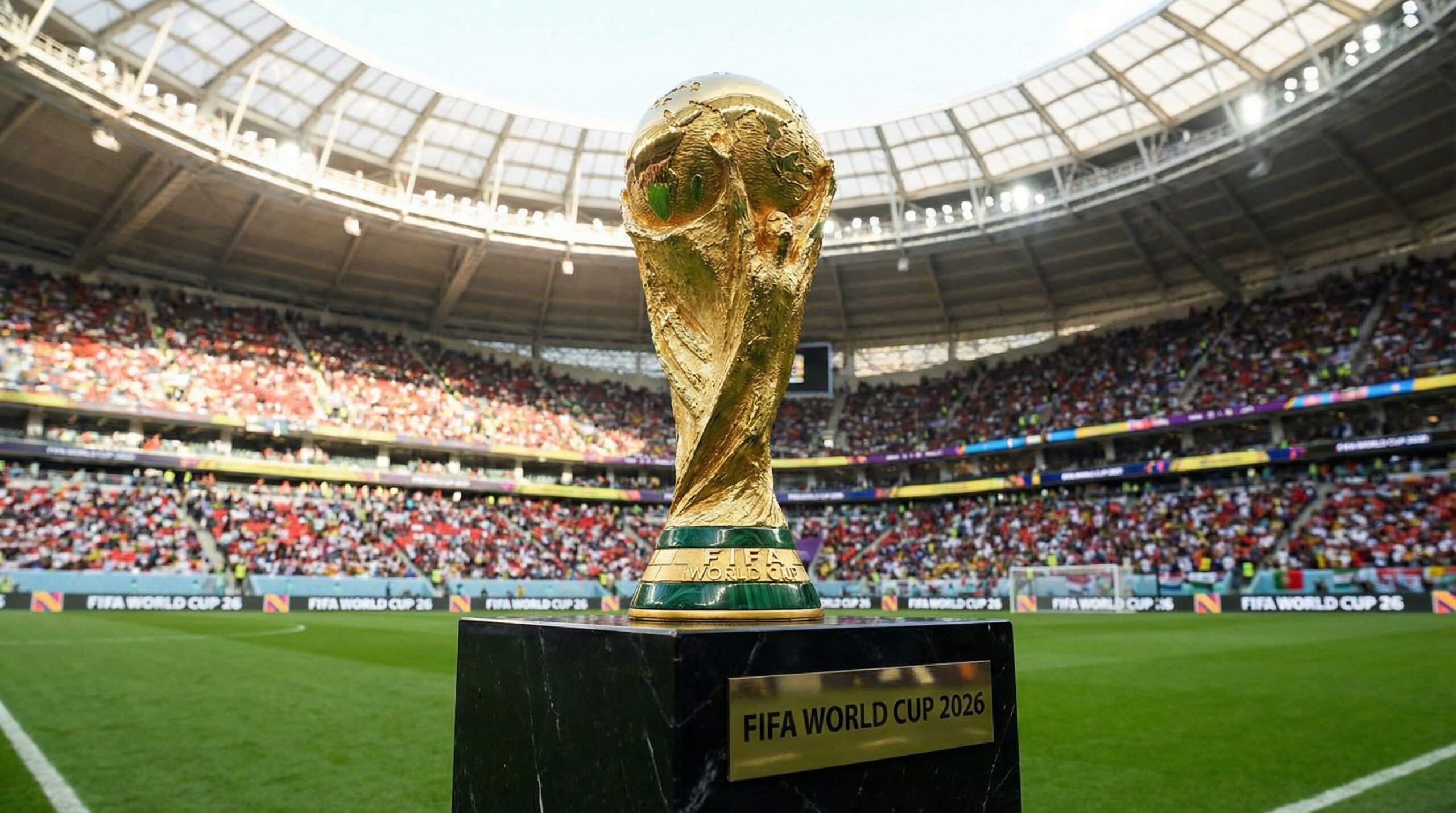
FIFA reveals 2026 World Cup groups in Washington
The FIFA World Cup draw played out with dramatic flair at Washington DC’s Kennedy Center on December 5. Soccer’s premier competition will see a new 48-team tournament format. The ceremony ran over two hours, and the actual draw started much later than expected.
Draw held at Kennedy Center with global attention
The star-studded ceremony had a distinct political vibe, happening just a mile from the White House with world leaders watching from the audience. Sports icons and entertainment stars joined soccer officials at the event. Tom Brady, Wayne Gretzky, Shaquille O’Neal, and Aaron Judge helped with the draw, bringing their star power to the stage.
The music added extra magic to the night. Andrea Bocelli kicked things off with a powerful “Nessun Dorma,” while Robbie Williams and Nicole Scherzinger’s performances fascinated viewers worldwide. The Village People wrapped up the show with “YMCA” – a song often heard at Trump rallies – which highlighted the event’s political undertones.
FIFA made history by giving its first-ever Peace Prize to U.S. President Donald Trump. He shared the moment with Mexican President Claudia Sheinbaum and Canadian Prime Minister Mark Carney. Trump’s acceptance speech was heartfelt: “This is truly one of the great honors of my life. We’ve saved millions and millions of lives”.
Expansion to 48 teams changes tournament dynamics
The 2026 tournament marks a major shift in World Cup history, expanding from 32 to 48 teams. The competition will now have 12 groups of four teams each. Two teams from each group move straight to the knockout phase. Eight best third-place teams will also go through, creating a new round of 32.
FIFA’s Chief of Global Football Development Arsène Wenger sees this as a natural step forward. “It’s a natural evolution. I think we want to make football global all over the world,” Wenger said, pointing out that less than 25% of FIFA’s 211 member nations will take part in the tournament.
The new format brings big changes. Game count jumps by 47% from 64 to 104 matches. The tournament will run for 39 days – a week longer than the 2010, 2014, and 2018 World Cups.
The tournament spreads across 16 venues in three countries, creating new challenges with multiple time zones. This setup differs from the 1994 U.S. World Cup, which mainly stayed on the East Coast. Now the action stretches from Vancouver to Mexico City.
FIFA President Infantino calls it ‘greatest event ever’
FIFA President Gianni Infantino can’t contain his excitement about the bigger tournament. He believes it will be “the greatest event that humanity, that mankind has ever seen and ever will see”. During the ceremony, he compared the World Cup to “104 Super Bowls in one month”.
Some worry about quality with more teams, but Infantino points to the recent 48-team FIFA U-17 World Cup in Qatar as proof it works. “In fact, we realized that the difference, quality-wise, between the different countries has been reduced,” he noted.
Qualification rounds have already produced exciting stories. Cape Verde, Curaçao, Jordan and Uzbekistan will make their World Cup debuts. Wenger explains this isn’t luck: “It’s no coincidence. We have made a world study, and we have realized that it’s a 100% correlation with the quality of the youth work and the success in the top team”.
North American soccer fans will get a rare chance to see the world’s best players compete on home soil. From small soccer academies in Burnaby to youth programs in New Westminster, this tournament opens doors that haven’t been available for decades.
USMNT lands favorable group with Paraguay and Australia
The US Men’s National Team let out a big sigh of relief after the FIFA World Cup draw revealed a surprisingly good Group D with Paraguay, Australia, and one of four European playoff teams. Australia ranked lowest in Pot 2 at 26th in the world rankings, and many analysts quickly called this one of the easier groups for any seeded team.
Group D opponents and historical matchups
The Americans have faced both confirmed opponents in recent friendly matches. They beat Australia 2-1 in Colorado last October and grabbed a similar 2-1 win over Paraguay in Philadelphia just last month. These wins have boosted the team’s confidence as they get ready for their tournament opener against Paraguay on June 12 at SoFi Stadium in Inglewood, California.
The squad heads to Seattle’s Lumen Field to play Australia on June 19, then returns to SoFi Stadium for their final group game against a European playoff winner on June 25. The fourth team will come from UEFA Playoff Path C, which includes:
- Turkey (FIFA Ranking: 25)
- Romania (FIFA Ranking: 47)
- Slovakia (FIFA Ranking: 45)
- Kosovo (FIFA Ranking: 80)
If Turkey makes it through the playoffs, they would be the third team the USMNT has played in recent friendlies – the Turks beat them 2-1 in June 2024. Young players in local soccer programs across North America, especially those in Burnaby and New Westminster soccer academies, are excited to watch competitive matches on home soil.
Coach Mauricio Pochettino reacts to draw
USMNT head coach Mauricio Pochettino showed careful optimism while respecting all opponents. “I think we need to be optimistic,” Pochettino told Fox right after the draw. “We need to keep pushing, keep evolving. But at the moment, what we can say is only to analyze the teams and see what is going on in a few months”.
The draw looks good on paper, but Pochettino warned against overconfidence: “I think we need to respect all the opponents. All of them are going to be difficult, and we know that very well”. He pointed out Paraguay’s strong South American qualifying campaign and Australia’s impressive 12-13 game unbeaten run before their recent friendly.
During a Telemundo event earlier, Pochettino had mentioned feeling “zero stress” about the draw, and called it “a unique situation” and “the biggest global event in any sport”.
Implications for U.S. advancement chances
This draw has improved America’s chances of moving past the group stage significantly. Fox analyst Alexi Lalas didn’t hold back: “Mauricio, I know you have to be respectful of the teams and everything, but when I look at the group, it would be an absolute disaster for the US not to get out of this group. I think you’re not only going to get out of the group. I think you’re going to win the group”.
The new 48-team format means the top two teams from each group automatically advance to the knockout stage, along with eight of the twelve third-place finishers. This generous structure, plus having Australia as what many see as the weakest Pot 2 team, puts the Americans in a good spot.
Paraguay still poses real challenges with talents like Atlanta United’s Miguel Almirón possibly playing. If Turkey emerges from the European playoffs, their world-class young stars Arda Guler and Kenan Yildiz could make things tougher for America.
Soccer clubs across North America are planning viewing events, as this favorable draw has gotten both casual and dedicated fans excited about the tournament.
Canada faces Switzerland, Qatar and playoff winner in Group B
Team Canada learned its World Cup fate as FIFA’s draw placed them in Group B with Switzerland, Qatar, and a yet-to-be-decided European playoff winner. The squad’s head coach Jesse Marsch watched his team get matched with the 17th-ranked Swiss and 51st-ranked Qatar. Many analysts call it a challenging but manageable path to the knockout stage.
Canada’s group stage schedule and venues
The Canadian team’s first World Cup match will make history against the UEFA Playoff A winner on June 12 in Toronto. This game marks the first FIFA World Cup match played on Canadian soil. The team then heads west to face Qatar on June 18 at BC Place in Vancouver. Their group stage wraps up against Switzerland on June 24, also in Vancouver.
Italy, Northern Ireland, Wales, and Bosnia and Herzegovina compete in UEFA Playoff A. The winners of Italy-Northern Ireland and Wales-Bosnia matches face off in March to determine Canada’s first opponent. Of course, if the 12th-ranked Italians advance as expected, Canada faces a tough test in their opener.
Toronto and Vancouver to host key matches
Canada’s two host cities will showcase 13 matches during the tournament. Vancouver gets seven games while Toronto hosts six. BC Place Stadium in Vancouver adds round of 32 and round of 16 matches to its schedule. The team could stay in Vancouver for both knockout rounds if they top Group B.
Toronto’s BMO Field kicks off with Team Canada’s opener on June 12. Local soccer academies and youth programs will experience international competition up close. Toronto residents showed tremendous enthusiasm with 248,000 volunteer applications – more than any other host city.
Local fan reactions and Christine Sinclair’s comments
Canadian soccer fans across the country showed mixed feelings about the draw. Toronto fans cheered loudly at Qatar’s placement in Group B, but seemed worried about a possible opening match against Italy.
Canadian soccer icon Christine Sinclair spoke about the tournament’s lasting impact at a Vancouver watch party. “Having the World Cup here is about a legacy and inspiring the next generation to be inspired and want to play for their country,” Sinclair remarked. “That moment happened for me watching a Women’s World Cup, so it’s amazing to think that kids who are watching these games in Vancouver could be playing for their country in 10 to 15 years”.
Soccer clubs and academies in Burnaby and New Westminster see this as a rare chance. Young players can now watch world-class competition in their backyard, sparking dreams of future Canadian soccer stars.
Trump awarded FIFA Peace Prize during draw ceremony
The FIFA World Cup draw ceremony took an unexpected turn when U.S. President Donald Trump became the first recipient of the newly created FIFA Peace Prize. What started as a soccer-focused event quickly evolved into one with distinct political overtones. FIFA President Gianni Infantino presented Trump with a golden trophy, medal, and certificate during what would normally be a tournament matchup announcement.
FIFA’s new award and its political undertones
FIFA created the Peace Prize just a month before the draw to recognize people “who have taken exceptional and extraordinary actions for peace”. The FIFA Council never got a chance to weigh in on the award’s creation. This raised questions about the organization’s steadfast dedication to political neutrality—a principle that’s part of its own statutes. Youth soccer programs watching the ceremony learned an unexpected lesson beyond the typical skill demonstrations at Burnaby soccer academies.
Trump’s acceptance speech and public response
Trump didn’t waste any time putting the gold medal around his neck and called it “truly one of the great honors of my life”. His brief acceptance speech included claims about “saving millions and millions of lives” and ending conflicts in places like Congo. “The world is a safer place now,” Trump declared. He added that America is “the hottest country anywhere in the world”. Soccer clubs in New Westminster had mixed reactions as they watched sports and politics collide in unprecedented fashion.
Celebrity appearances: Tom Brady, Shaq, Gretzky
The globally watched event featured several sports icons who helped with the draw proceedings. Tom Brady, a former judge at Trump’s Miss USA pageant in 2002, joined basketball legend Shaquille O’Neal and hockey great Wayne Gretzky as draw assistants. Gretzky’s connection to Trump goes beyond sports—he attended Trump’s presidential inauguration in January with FIFA President Infantino. Local soccer classes in Burnaby noticed how these celebrities added star power to an already glittering ceremony that balanced sports and politics.
Which groups pose the biggest challenge in 2026?
The FIFA World Cup draw has finished, and attention quickly turns to the tournament’s toughest matchups. Several groups have emerged as especially tough challenges that will test even the most accomplished teams.
Group L dubbed ‘Group of Death’ with England and Croatia
Group L has earned the dreaded “Group of Death” label. The group features England (ranked 4th) with Croatia (ranked 10th), Ghana (ranked 72nd), and Panama (ranked 30th). This setup recreates the 2018 World Cup semifinal clash between England and Croatia, where the Croats broke English hearts in extra time. Young players at soccer academies in Burnaby will without doubt be talking about this high-stakes rematch between two European powerhouses.
Other tough groups and potential early knockouts
Group I stands as another brutally competitive bracket. France will face Senegal, Norway, and a playoff winner. This setup leads to an electrifying showdown between superstars Kylian Mbappé and Erling Haaland. Group C presents a tough challenge with Brazil facing Morocco, Haiti, and Scotland. Soccer clubs in New Westminster have already started planning special viewing sessions for these marquee matchups.
How new format affects group stage dynamics
The expanded tournament format makes it less punishing to land in a difficult group. The top two teams from each group qualify automatically, and eight third-place finishers will also advance. The path through these challenging groups remains crucial—since 1982, all but three teams that won the World Cup emerged from a Group of Death. Soccer classes that teach tournament strategies find this new format creates fascinating tactical options to learn about.
Conclusion
The 2026 FIFA World Cup will be a defining moment for soccer in North America. This expanded 48-team format will revolutionize international competition and bring unmatched excitement to fans in Canada, Mexico, and the United States. Young players at local soccer academies from Burnaby to New Westminster will feel inspired when they see world-class talent play in their backyard.
The tournament features 104 matches—or as Infantino colorfully put it, “104 Super Bowls in one month.” Soccer clubs across North America expect record crowds as excitement builds. Fans rarely get chances to watch Mbappé battle Haaland or see England face Croatia in a World Cup semifinal rematch on this continent.
The draw created both excitement and controversy. The USMNT landed in a favorable Group D with Paraguay, Australia, and a European playoff winner. Team Canada’s path looks challenging but doable against Switzerland, Qatar, and potentially Italy. Both North American hosts have a good shot at reaching the knockout stages, thanks to the new format that lets eight third-place teams advance.
The ceremony took an unexpected turn that surprised many observers. FIFA’s Peace Prize award to President Trump turned what’s usually just a sporting event into something more politically charged. Whatever your political views, this shows how the tournament’s influence goes way beyond sports.
Soccer classes in Burnaby and New Westminster have started teaching lessons from this historic draw. Today’s young players might compete in future World Cups, inspired by matches played close to home. As Christine Sinclair pointed out, kids watching these Vancouver games could wear Canada’s colors internationally within ten years.
The countdown begins for what FIFA President Infantino called “the greatest event that humanity, that mankind has ever seen.” While this might sound over the top, the tournament’s massive scale—covering three nations, 16 venues, and more teams than ever—suggests this North American World Cup will make history. Soccer fans from Burnaby’s academies to New Westminster’s clubs can’t wait for June 2026, ready to see their sport reach new heights on home soil.
Key Takeaways
The 2026 FIFA World Cup draw has set the stage for a historic tournament that will transform soccer in North America with unprecedented scale and political intrigue.
• The tournament expands to 48 teams across 12 groups, increasing matches from 64 to 104 games over 39 days across three countries
• USMNT received a favorable Group D draw with Paraguay and Australia, while Canada faces tougher opposition including Switzerland and Qatar
• Group L emerges as the “Group of Death” featuring England vs Croatia rematch alongside Ghana and Panama
• FIFA controversially awarded its inaugural Peace Prize to President Trump during the ceremony, mixing politics with sports
• The expanded format allows eight third-place teams to advance, creating more forgiving qualification paths for host nations
This North American World Cup represents the largest and most geographically diverse tournament in FIFA history, promising to inspire a new generation of soccer players while delivering unprecedented global spectacle across 16 venues from Vancouver to Mexico City.